Kiwi Cultivation (Actinidia spp.)
General Characteristics
Kiwi (Actinidia spp.) belongs to the family Actinidiaceae and is a perennial, deciduous, dioecious climbing shrub native to China.
In Greece, it is cultivated in areas with favorable soil and climatic conditions, primarily in Macedonia and Epirus.
Propagation and Transplanting
Propagation is mainly done through cuttings and grafting, although seeds can also be used.
The ideal transplanting period is spring, after the last frost.
A support system should be installed before or after planting to sustain the vigorous growth of the plants.
Soil Preparation
Before planting, the soil should be plowed to a depth of 30–40 cm to eliminate perennial weeds and improve soil structure, which is essential for root system development.
Kiwi thrives in fertile, well-drained soils rich in organic matter, with an optimal pH of 5.5–7, and young plants are sensitive to strong winds during early growth.
Planting Distances and Layout
Planting distances depend on the training system and should be carefully observed to ensure:
- proper development,
- good airflow,
- disease prevention,
- ease of machinery operation.
Each kiwi orchard includes male and female plants, with a typical ratio of 1:5 to 1:9.
Fruit production usually begins in the second year.
Climatic Requirements
Optimal soil temperatures for growth range between 12–29°C, while the ideal ambient temperature for development is 12–19°C.
Frost can cause severe damage, and prolonged high temperatures reduce fruit quality.
Irrigation
Kiwi requires stable soil moisture, especially in the surface soil layer where most roots are concentrated.
Frequent irrigation is essential, potentially every two days, depending on soil type and climatic conditions, especially after transplanting.
Drip Irrigation
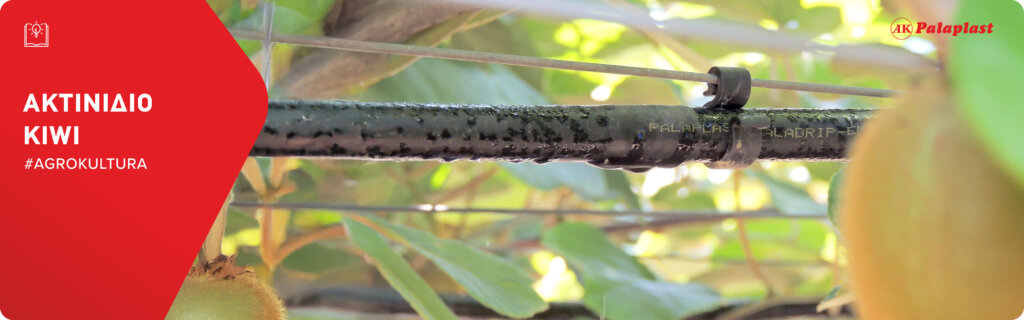
Drip irrigation is the most efficient method, ensuring:
- precise water delivery,
- minimal evaporation,
- virtually no runoff,
- up to 50% water savings,
- possibility of fertigation.
Micro-Sprinklers
Alternatively, micro-sprinklers can be installed along the trellis wires of the support system.
Using modern irrigation systems maximizes yield, reduces costs, and conserves water.
Nutrient Requirements and Fertilization
Kiwi has high nutrient demands, particularly for nitrogen to support foliage development.
It also requires phosphorus, potassium, calcium, magnesium, and trace elements such as manganese, zinc, copper, and boron.
Proper fertilization includes:
- basal applications during or before planting,
- supplementary applications during the growing season.
Fertigation ensures precise nutrient management, while organic amendments improve soil structure.
A soil analysis before planting is essential to identify any deficiencies.
Pests and Diseases
Kiwi is susceptible to weeds, insects, and diseases, including:
- cottony cushion scale,
- brown rot,
- nematodes,
- bacterial canker (the most serious),
- wood diseases,
- phytophthora infections.
Prevention, monitoring, and timely treatment with appropriate chemical solutions under the supervision of an agronomist are essential for healthy production.
Frost Sensitivity and Protection
During spring, when sap flow and bud break occur, kiwi plants become highly sensitive to frost, even at -2 to 2°C.
Radiative frost can cause severe damage, requiring frost protection using the irrigation system.
Approximately 3–5 m³ of water per hour per acre is needed for effective frost control.
As water freezes on the plants, it releases heat, maintaining temperatures at safe levels for the tissue.
Correct timing of activation and shutdown of the system is critical, depending on plant development — younger plants are generally less vulnerable.
Example
If a pump delivers 47 m³/h, it can cover up to 15.6 acres.